
Why Does My Gut Hurt?
Gut Pain Isn’t Always About Food
Are you the type of person who when someone asks, “How are you?”, and you reply with pride “Ah, I’m fine, just busy, busy”. Have you ever stopped to wonder why we store such value around being busy? Somewhere along the line, in our modern world, we have started wearing busy as a badge of honour. It can make us feel needed, productive or successful. But what if the constant pressure of living this way is one of the reasons your gut hurts?
I know lots of busy women, indeed I used to be one myself. Rudely jolted awake by an early alarm clock, rushing breakfast, the school run, traffic, packed train, emails, meetings, lunch at your desk, home at the end of the day to start your second job; taking care of the home, children, parents, partner, organising, shopping, and washing … throwing a ready-made meal into the oven or microwave because it is easy and it’s something. Then rinse and repeat the next day with a few variations. Never enough time, always stressed, perpetually pushing, head buzzing, gut pain, tired and wired.
I remember wondering why am I the only one that's tired and struggling? Everyone else seemed to cope better than I did. I thought if I just kept pushing through everything will be fine. I'll ignore this tiredness and abdominal pain and just have a glass of wine, perhaps that will make me feel better. Except it never did.
Looking back, I can see that my body had been communicating with me for years. It wasn’t whispering, it was shouting. It was sending important signals through my nervous system and my digestive system. It was sending message after message that something needed to change. I was so determined that this was how a successful life was supposed to be that I wasn’t listening. Looking back, the signs were there all along:
· Bloating
· Constipation
· IBS
· Headaches
· Chronic stress
· Anxiety
· Exhaustion
None of these symptoms appeared out of nowhere. They weren’t random. They were a collection of messages from my body asking for help, asking for change, asking me to slow down and listen.
Over time, we learn how to override these messages. We choose caffeine over rest. We eat while answering emails. We ignore the tension in our shoulders, dismiss the bloating as ‘normal’ and push through fatigue. Gradually, we become disconnected from the quieter signals our body is sending until it has no choice but to speak louder.
"Healing begins when we stop fighting our bodies and start listening to them."
Your Body is Always Talking – Are you Listening?
Looking back, I realise my body had been trying to communicate with me for years. I just didn't know how to recognise its messages. There is actually a name for this ability to notice and understand what's happening inside your body. It’s called interoception. Simply put, it is our internal sensing system. It helps us recognise when we're hungry, thirsty, tired, tense, calm, anxious, full, or in pain. It's how we become aware of our heartbeat, our breathing, butterflies in our stomach or the early signs that we're becoming overwhelmed.
Practices such as yoga and meditation have encouraged people to tune into these internal sensations for thousands of years. More recently, scientific research has begun to explain the physiology behind why these practices can be so beneficial. To understand why interoception matters for your gut, we first need to look at your nervous system.
Your Nervous System
When you are busy and rushing around all the time, your nervous system is affected. You can easily become stuck in a stressful state, the sympathetic Fight or Flight response. In this state, your body prioritises survival, it diverts blood flow from your digestive organs, reduces digestive secretions and can affect the movement of food through your digestive tract. For many people, it slows down and for some, it can speed up.The opposite of Flight or Flight is our parasympathetic system, often called Rest and Digest. This is the state where digestion, repair and recovery can happen most efficiently. When in Fight or Flight, you might notice:
Stomach symptoms
- Indigestion
- Feeling full quickly
- Nausea
- Reduced appetite
Digestive symptoms
- Bloating
- Wind
- Cramping
- Constipation
- Abdominal pain
- IBS flare ups
Food-related symptoms
- Foods seem harder to tolerate
- Feeling uncomfortable after meals
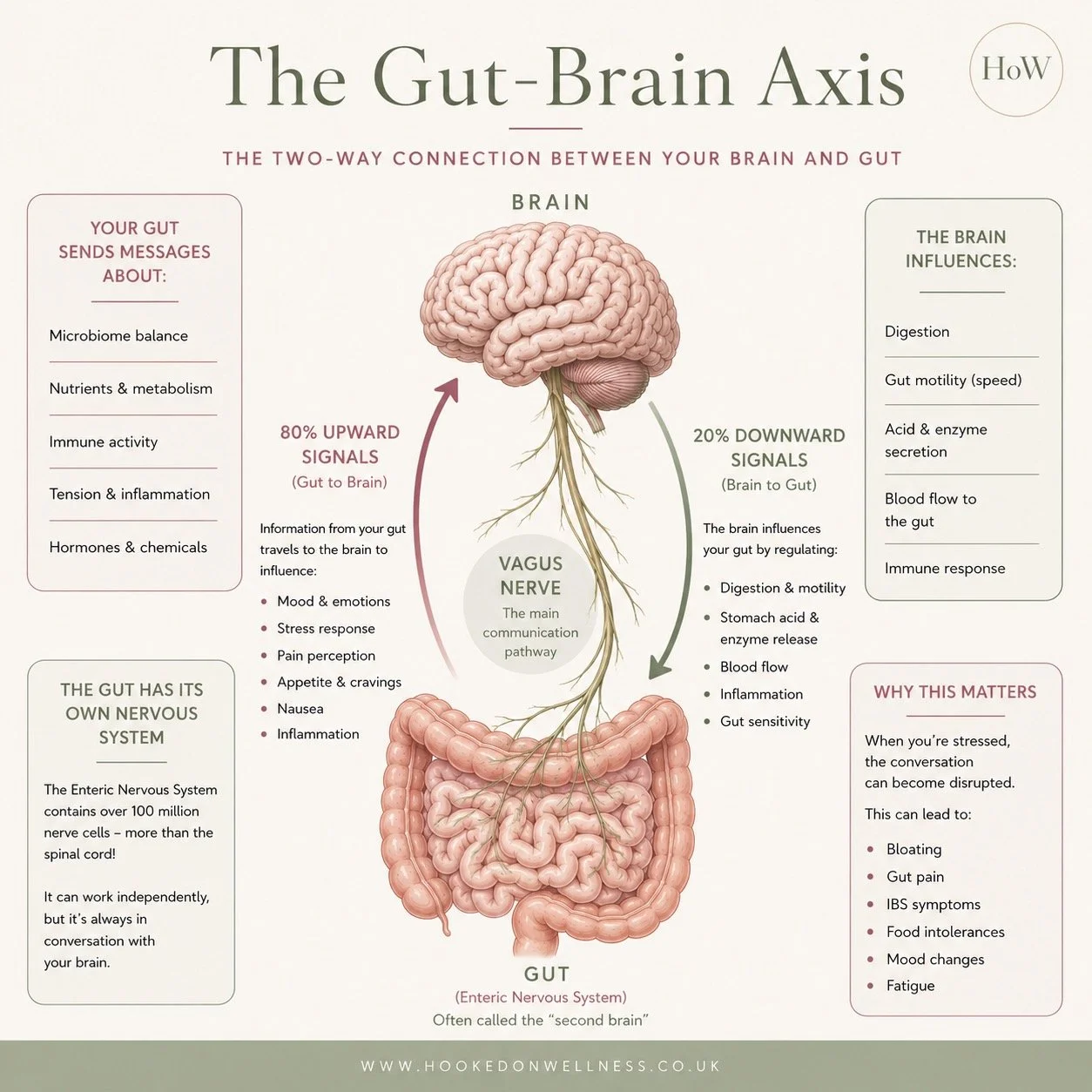
Part of your nervous system links your gut and your brain. This is called the Gut-Brain Axis or Gut-Brain Connection. One of the most important communication pathways within the gut-brain connection is the vagus nerve. It provides a two-way communication pathway between the gut and the brain.
If like me, you are thinking that most of the communication goes from the brain to the gut, you’d be incorrect. One fascinating fact is that around 80% of the fibres in the vagus nerve carry information from your body to your brain. Amazing! In other words, your body is constantly updating your brain about what's happening inside you. The challenge isn't that the messages aren't being sent—it's that many of us have become so accustomed to overriding them that we no longer consciously notice them until they become loud enough to demand our attention.
Visceral Hypersensitivity
Many people with IBS also experience something called visceral hypersensitivity. This means the nerves in the digestive tract become more sensitive than usual, so normal stretching or movement of the bowel may be experienced as pain or discomfort. Stress doesn't cause this on its own, but it can amplify how these signals are processed through the gut-brain connection.
Reconnecting with your Body
The wonderful thing about interoception is that it isn't something you're born with or without—it's a skill that can be developed. Yoga has encouraged people to cultivate this awareness for thousands of years through breath, movement and meditation. Today, neuroscience is helping us understand why these practices work. The good news is that you don't have to spend hours meditating to improve your interoception. Small, intentional moments throughout the day can help you reconnect with your body's signals and begin rebuilding the conversation between your brain and your gut.
Perhaps your body has been speaking to you all along. The question is not whether it's communicating—it's whether you've had the time, space and awareness to hear it.
Interoception can be improved
Yes, the good news is that interoception is a skill that can be developed. Just as you can strengthen a muscle through regular practice, you can improve your ability to notice and respond to your body’s signals. Small and consistent moments of awareness throughout the day can make a surprising difference.
Start by pausing for just a minute or two. Begin by closing your eyes if it feels comfortable to do so and simply notice what you feel, allow your intuition to guide you. Maybe you notice you are holding tension, perhaps in the jaw or shoulders, a feeling of tiredness, maybe you feel hunger or discomfort in your stomach. Leaning into your curiosity rather than trying to find the ‘right’ answer. Every sensation, or even the absence of sensation, is valuable information. The goal isn’t to judge what you notice but to become aware of it so that you can make an informed decision.
Everyday Ways to Build Interoception
Pause Before Eating
This simple practice signals to your nervous system that you're safe, helping you shift from "fight or flight" towards "rest and digest". It creates a calmer environment for digestion and gives you an opportunity to check in with how you're feeling before your first mouthful.
Mindful eating
Start by eating one meal each day without distractions. Put your phone away, turn off the television and step away from your computer. Notice the colours, textures and aromas of your food. Chew slowly and pay attention to how your body responds as you eat. Can you recognise the moment you begin to feel comfortably satisfied? See if you can slowly increase this to each mealtime.
Practices That Help Calm the Nervous System
Extended Exhale
Different styles of breathwork bring about different ways of feeling and directly impact the nervous system. It is important to choose or to learn a breath that will calm your nervous system bringing it back into regulation and help to reduce your cortisol levels and support healthy digestion. An extended exhale breath can be perfect if you are feeling stressed and looking to calm things down.
Try breathing in gently for a count of four and breathing out for a count of six. Continue for two to five minutes, breathing comfortably rather than forcing the breath. Afterwards, simply notice how your body feels. Has anything changed?
Body Scans
A body scan is one of the most effective ways of developing interoception. Rather than trying to relax, the aim is simply to notice what's already there.
Slowly bring your attention to different parts of your body, observing sensations such as warmth, tension, tingling, heaviness, lightness or even the absence of sensation. You are not trying to change anything, only observing with kindness and curiosity.
Like any skill, the more you practise, the easier it becomes to recognise your body's quieter messages before they develop into louder symptoms.

When to seek Medical Advice
While many digestive symptoms can be influenced by stress and the nervous system, they should never be dismissed without appropriate medical assessment.
You should always seek advice from your GP or another healthcare professional if you experience:
Persistent or severe abdominal pain
Unexplained weight loss
Blood in your stool
Persistent vomiting
Fever
Difficulty swallowing
Any other new or concerning symptoms
Final Thoughts
Gut pain is rarely caused by one single factor. Diet, the gut microbiome, infections, hormones, inflammation, medications, sleep, stress and nervous system regulation can all play a role. Understanding your body's signals is one important piece of a much bigger picture.
Your body has been communicating with you since the day you were born. It speaks through sensations, emotions, energy levels, digestion and pain. The challenge is that many of us have become so busy that we've forgotten how to listen, we have become disconnected.
Learning to reconnect with your body's signals doesn't happen overnight. Like any new skill, it takes time, patience and practice. Be kind to yourself as you begin. Every pause, every breath and every moment of awareness is a step towards understanding your body a little better. Your symptoms are not your enemy. They are often your body's way of asking for support.
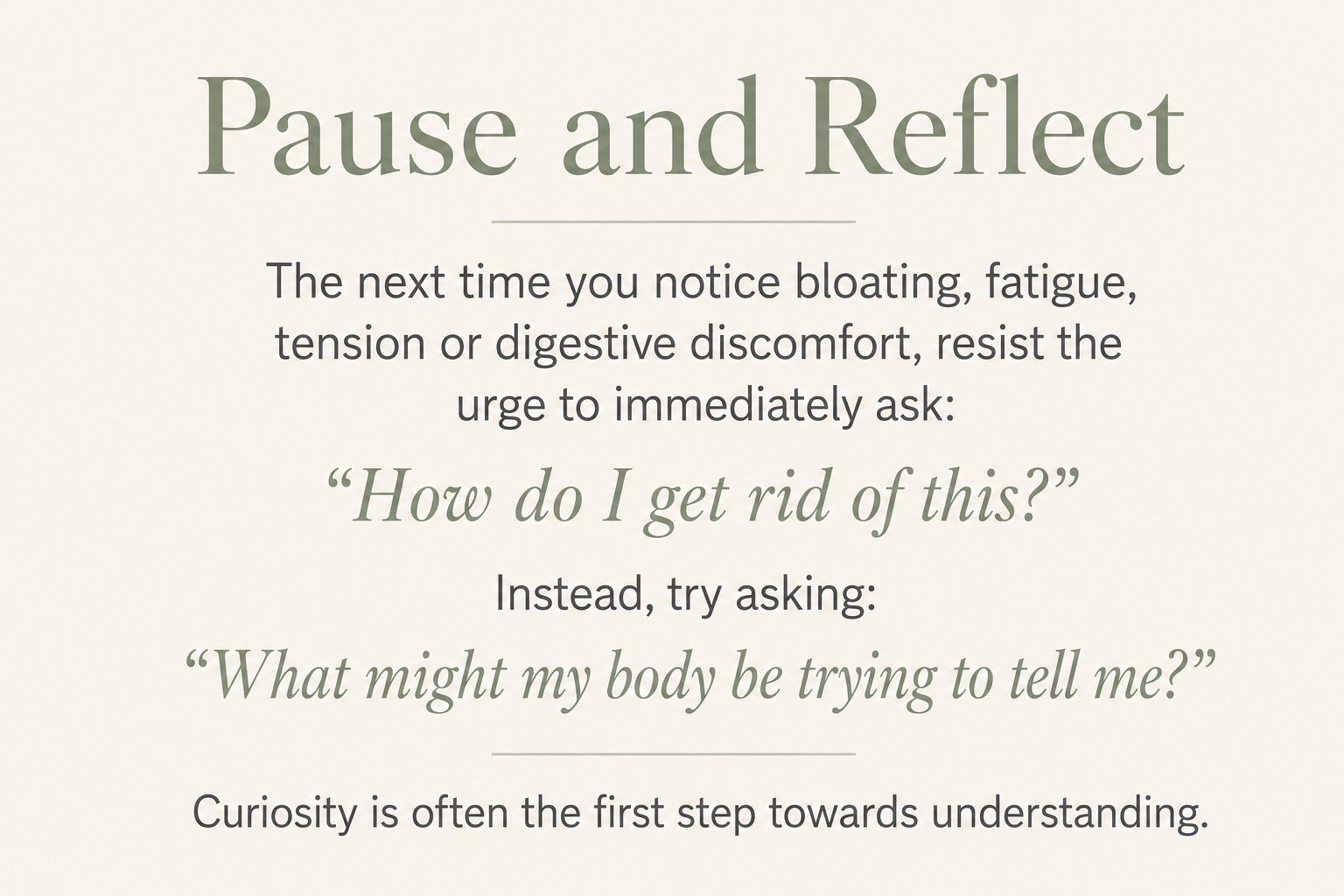
Perhaps the most powerful question you can ask yourself isn't, "How do I make this symptom disappear?" but rather, "What is my body trying to tell me?".
Listening to your body does not mean becoming fearful of every sensation. Its means becoming curios to understand what your body may be asking for.
If you've recognised yourself in this article and you're ready to better understand what your body has been trying to tell you, I'd love to help. Through my one-to-one Functional Wellness coaching, we'll explore the factors influencing your gut health, nervous system and overall wellbeing, and create a personalised plan that supports lasting change—one step at a time.
Listening to your body doesn’t mean becoming fearful of every sensation. It means becoming curious enough to understand what your body may be asking for.
Further Reading & References
This article is based on current scientific understanding of the gut-brain axis, interoception, stress physiology and digestive health. If you would like to explore these topics further, the following resources provide an excellent starting point.
American Gastroenterological Association. (2021). AGA Clinical Practice Update on Management of Functional Gastrointestinal Symptoms. Gastroenterology.
Barrett, K. E., et al. (2023). Gastrointestinal Physiology (3rd ed.). McGraw-Hill Education.
Chen, W. G., et al. (2021). The Emerging Science of Interoception: Sensing, Integrating, Interpreting, and Regulating Signals within the Self. Trends in Neurosciences, 44(1), 3–16.
Drossman, D. A., & Hasler, W. L. (2016). Rome IV—Functional Gastrointestinal Disorders: Disorders of Gut-Brain Interaction. Gastroenterology, 150(6), 1257–1261.
Guyton, A. C., & Hall, J. E. (2021). Guyton and Hall Textbook of Medical Physiology (14th ed.). Elsevier.
Kabat-Zinn, J. (1990). Full Catastrophe Living: Using the Wisdom of Your Body and Mind to Face Stress, Pain and Illness. Delacorte Press.
Karagiannidis, I., et al. (2024). Interoceptive Processing in Disorders of Gut-Brain Interaction: Implications for Pathophysiology and Treatment. Neurogastroenterology & Motility.
National Institute for Health and Care Excellence (NICE). (2021). Irritable Bowel Syndrome in Adults: Diagnosis and Management (CG61).
Porges, S. W. (2011). The Polyvagal Theory: Neurophysiological Foundations of Emotions, Attachment, Communication and Self-Regulation. W. W. Norton & Company.
Sapolsky, R. M. (2004). Why Zebras Don't Get Ulcers (3rd ed.). Henry Holt and Company.
Wang, R. L., & Chang, R. B. (2024). The Coding Logic of Interoception. Annual Review of Physiology, 86, 201–225.
Please note: This article is intended for educational purposes only and should not replace personalised medical advice. If you have persistent, worsening or concerning digestive symptoms, please seek advice from your GP or another qualified healthcare professional.