
Blood Sugars: Mood, Food & Energy
Blood Sugar Imbalances
It's amazing what you can get used to. We can get used to feeling tired ALL the time. Feeling that slump mid-afternoon. Reaching for caffeine and cake to keep us going. The brain fog, struggling to think, and then the craaaavings … biscuits, caffeine, pancakes, cakes, potatoes, I love potatoes. Yet despite munching away all the time, I never felt completely satisfied.
I used to have a breakfast of porridge or muesli or cereal, and by 10:00 am, I'd be reaching for tea and biscuits. For lunch I might have a jacket potato with a nice filling and then mid-afternoon. I would be looking for more tea and biscuits, or cake, to help me concentrate to make my way through the rest of the day. For dinner I might have some pasta and then I would still want some snacks in the evening. I might reach for some crisps, possibly with some fizzy juice, or wine at the weekend. I was so tired, that I used to daydream about just lying down and closing my eyes. Does any of this sound familiar?
Learning how to manage my blood sugars changed how I felt, my energy levels and my ability to think clearly. I no longer rely on caffeine nor am I constantly reaching for the biscuit tin. It was so worth taking the time to find out more. You don't realise that you can feel better until you do.
Throughout this blog, I may use ‘blood sugar’ and ‘blood glucose’ interchangeably. Blood glucose is the specific sugar we measure in the bloodstream. For a full explanation of all the blood sugar hormones, see the What are Blood Sugar Hormones? blog.
Common Emotions of Blood Sugar Imbalances
Blood sugars naturally rise and fall throughout the day. However, with our modern diet laden with sugars, the speed and size of these fluctuations can impact how we think and feel. We aren’t talking about the same degree of glucose dysregulation as seen in conditions such as prediabetes. We are talking about how blood glucose fluctuations may affect how some people feel on a daily basis. We may be experiencing increased irritability, anxiety, low mood, or feel more emotionally reactive.
Many of us will have heard of the blood sugar roller coaster or maybe we've heard of insulin in the context of diabetes or prediabetes. You don't however have to be diabetic or prediabetic in order to reap the benefits of stable blood sugars. You can change how you feel and your mood.
Before we look at the blood sugar roller coaster, let's take a moment to review the main food groups to aid our understanding.
The Main Food Groups - Macronutrients
Protein
Meat, fish, eggs, Greek yogurt, cottage cheese, tofu, tempeh
Relatively limited direct effect on blood glucose
Fats
Extra virgin olive oil, avocado, nuts, seeds, oily fish
Little direct effect on blood glucose and it can slow glucose absorption
Carbohydrates
There are different types
The greatest direct effect on blood glucose, however the response is nuanced.
With fibre
Fruit, vegetables, whole grains
The fibre structure slows down digestion and glucose absorption.
Fibre Removed
Orange juice, apple juice
The glucose can enter the blood stream more quickly
Processed carbohydrates
Bread, sweets, cakes, biscuits, crisps
The glucose can enter the blood stream more quickly
*This isn’t a complete list of foods, only some examples.
The Blood Sugar Rollercoaster
So … what’s going on I hear you cry! Let’s imagine a day when you are eating similarly to how I described I used to eat. I used to think I had a reasonably healthy diet. After all, this was how my parents ate and everyone I knew.
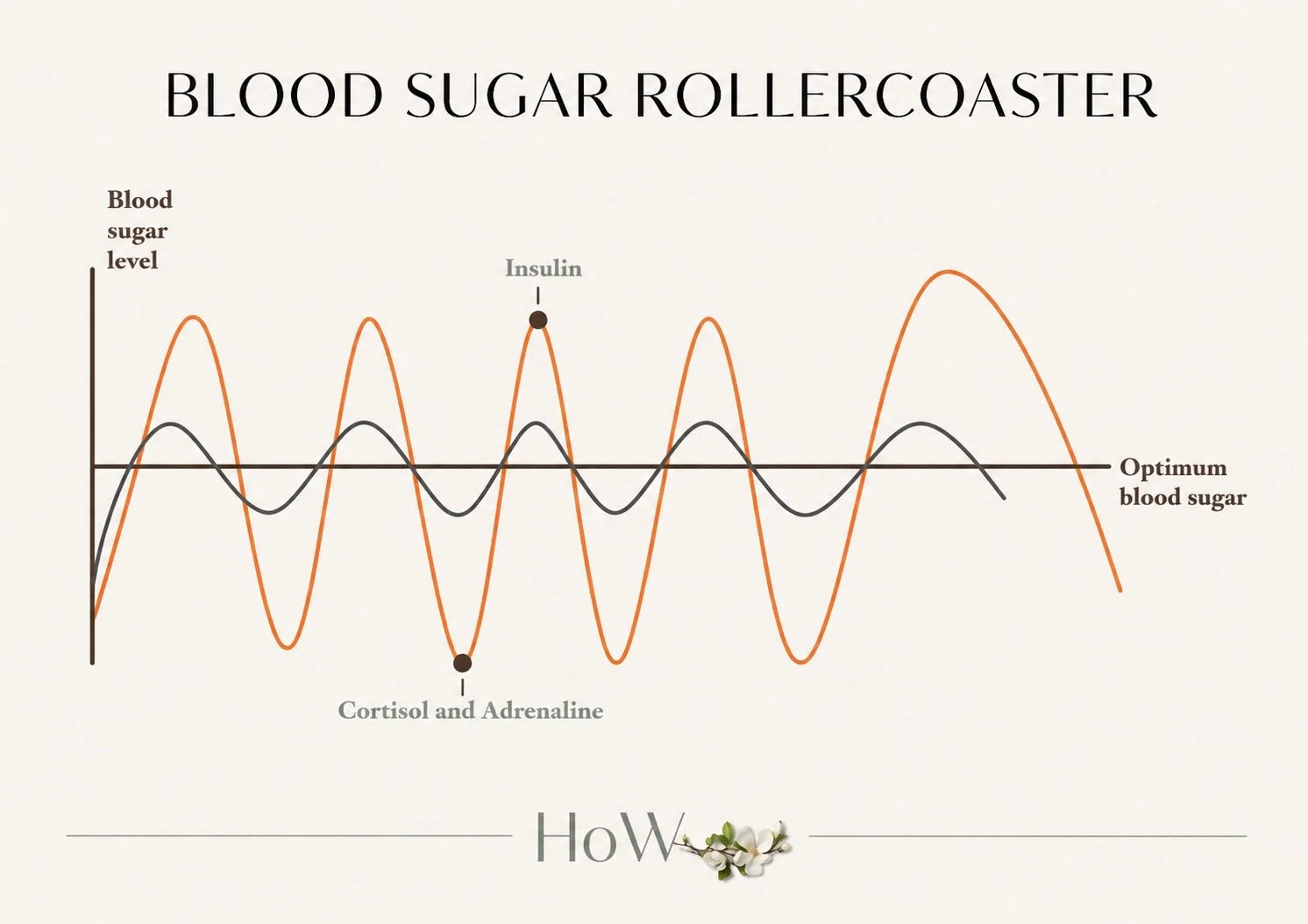
When you eat muesli or cornflakes for breakfast, it causes your blood sugars (glucose) to spike (see the orange line in the graph, look for the first peak), your body is very clever, and it likes to keep things in balance. It will therefore deploy the hormone insulin to sweep up the glucose, store it in the liver, the muscles or turn it into triglycerides and store excess energy as fat.
Notice how in the graph there is a big drop in blood sugar levels after insulin has been released (same orange line, this time look for the first dip). When a meal produces a large or rapid glucose rise, the subsequent fall can sometimes be more pronounced. For some people, this may coincide with feelings of increased hunger, tiredness or cravings.
In my example, I craved my 10:00 am cup of tea and a couple of biscuits. My carbohydrate breakfast spiked my blood sugars (glucose), insulin stored them away and I was left feeling hungry and craving more sugar, i.e. my biscuits. The whole process repeats with my jacket potato at lunchtime, my tea and cake at 3:00 am, and the pasta for my dinner. There's a bit of a theme going on. I'm sure you might have noticed it. Most of the things I had been eating, came from the carbohydrate food group.
The darker line represents a steadier blood glucose pattern. You will notice that it isn't flat, nor do we want it to be, and we definitely don't want to generate a fear of carbohydrates. Because we do need carbohydrates in our diet. Carbohydrates in balance with protein and healthy fats.
Is this something that resonates with you? Do you eat in a similar way? Is that how you learned to eat from your family, advertising, what's available in the supermarket or the influence of the low-fat movement? And what can you do about it? I think that it is worth taking steps to improve your mood, your energy, reduce your brain fog and reduce your cravings.
Please bear in mind that everyone is different. Sarah Berry's work through the PREDICT research programme has shown that individuals can have very different glucose and metabolic responses to the same foods.
Blood sugar regulation is a part of the story. It isn't the full story. Other factors could be contributing towards these symptoms. Those include how you sleep, your stress levels, your sex hormones, the size of your meals, your hydration levels, the amount of activity that you have undertaken, and many other factors. By balancing your blood sugars, you are conducting good health housekeeping.
The Role of Stress from Low Blood Sugars
The eagle-eyed amongst you might have noticed that cortisol and adrenaline make an appearance at the bottom of the Blood Sugar Rollercoaster graph. You might know cortisol and adrenaline in relation to your fight, flight and freeze response. They also play an important role in the body's response to low blood glucose.
When blood glucose falls too low, the body has protective mechanisms designed to bring it back up. Insulin secretion decreases, while hormones including glucagon, adrenaline and cortisol help mobilise stored energy and increase the availability of glucose.
Adrenaline is part of the body's rapid response. It can produce sensations such as a racing heart, shakiness, sweating, hunger and feeling on edge. These physical sensations can feel very similar to anxiety, even though the trigger is physiological rather than psychological.
The Energy Impact
After we eat, our bodies move into a different metabolic state. Glucose from carbohydrate becomes more available in the bloodstream and the pancreas responds by releasing insulin. Insulin helps glucose move into our cells to be used for energy or stored for later.
If a meal produces a large or rapid rise in glucose, the body has to respond accordingly. Glucose and insulin then come back down as the glucose is taken up and stored. For some people, this larger rise and subsequent fall may coincide with a noticeable change in how they feel.
This can be experienced as:
tiredness
lethargy
sleepiness
feeling “flat”
difficulty concentrating
reaching for caffeine
the familiar afternoon slump
But what's happening isn't simply that your blood sugar has fallen and you've suddenly run out of energy. Your body has sophisticated systems for maintaining blood glucose and supplying your cells with fuel.
Instead, think of it as a change in the body's metabolic state. Following a meal, hormones including insulin and gut hormones influence how quickly nutrients are absorbed, how glucose is used and stored, and how hungry or satisfied we feel. The size and timing of these responses vary from person to person.
There is also a natural tendency towards greater sleepiness in the afternoon, linked to our circadian rhythm, so the classic post-lunch slump isn't necessarily caused by the meal itself. The meal, its size and composition, sleep, stress and your individual glucose response may all contribute.
Brain Fog
Do you have to re-read things many times? Do you have to re-read things many times? Feel like your brain is wading through treacle? Find difficulty in concentrating? It's frustrating! I know.
There's no other way to put it really, our brains are quite greedy when it comes to energy. They demand a lot of fuel. Although our brain only accounts for around 2% of our body weight, it uses around 20% of the body’s energy when at rest. Glucose is the brain’s main fuel source under normal conditions. It can also use ketones which are produced from fat when glucose availability is reduced.
When the availability of glucose is irregular or unstable, for example when blood sugars fluctuate up and down, those fluctuations may coincide with brain fog symptoms, struggling to concentrate or reduced mental sharpness.
And there is another fascinating piece of the story. Lisa Mosconi's work has highlighted the relationship between oestrogen, brain metabolism and cognitive health. This may be particularly relevant during menopause, when changing oestrogen levels can affect brain energy metabolism and contribute to the brain fog many women experience.
The brain is part of the blood sugar story too, and how well we feel mentally is another part of the picture.
Cravings
Cravings can feel like they're all about willpower, but they're often your body's way of asking for something. When blood glucose falls, particularly after a long gap between meals or following a rapid rise and fall, your body has ways of encouraging you to seek out food. Hunger can become more noticeable, and the desire for quickly available energy can become particularly strong.
This is one reason you might find yourself reaching for biscuits, cake, chocolate or crisps when you're tired or hungry. These foods provide readily available energy and can feel particularly appealing in that moment.
But cravings aren't caused by blood sugar alone. Sleep, stress, restriction, habits, emotions, food reward and simply not eating enough can all influence what we crave. The good news is that you don't need to fight your cravings with willpower. Eating regular, satisfying meals containing protein, healthy fats, fibre and good-quality carbohydrates can help support steadier energy and keep you feeling satisfied for longer.
The aim isn't to eliminate cravings or be “perfect”. It's to understand what your body might be asking for and give it what it needs.
How to Stabilise Blood Sugars
For steadier mood
Build meals around protein, fibre and minimally processed foods.
Avoid routinely going for very long periods without eating if that leaves you shaky, irritable or ravenous.
Pair carbohydrates with protein, fibre and healthy fats rather than eating carbohydrate in isolation.
Pay attention to how different meals affect your mood.
For steadier energy
Start meals with a good source of protein.
Include plenty of fibre-rich plants.
Include healthy fats.
Avoid relying on sugary foods for an energy boost.
Consider a short walk after meals.
For clearer thinking
Don't skip meals and then compensate with highly refined carbohydrates.
Build balanced meals rather than chasing quick glucose.
Prioritise sleep — because glucose regulation and sleep are closely interconnected.
Notice whether meals consistently leave you foggy or sleepy.
For fewer cravings
Eat enough at meals as under-eating can drive cravings.
Include protein, healthy fats and fibre rich carbohydrates.
Don't demonise carbohydrates; combine them intelligently.
Reduce the “restrict → crave → overeat → restrict” cycle.
Look at sleep and stress as well as food.
Blood sugar stability isn't about never allowing your glucose to rise. Nor is it about avoiding carbs, or worrying about your food choices. Life isn't about perfection. Life is about understanding, kindness and compassion. We are all human beings.
If you can create a pattern of balanced healthy eating whereby you look at each meal and can identify a good source of protein, a healthy fat, and fibre rich carbohydrates, then you're doing a great job.
Changes take time and they take practice. You will notice the difference when you move away, as I did, from a very heavy carbohydrate dominant diet. We all want to feel more consistent energy, to be able to think clearly, and not be at the mercy of our cravings or are fluctuating moods. One small step at a time.